At Innovety, we create end-to-end socioeconomic development programs that deliver measurable results for people and economies.
We design skill development programs so public sector institutions can deliver better services, youth and women can access decent work or start their own businesses, and MSMEs can scale into new markets.
This isn’t abstract development, it’s about delivering:
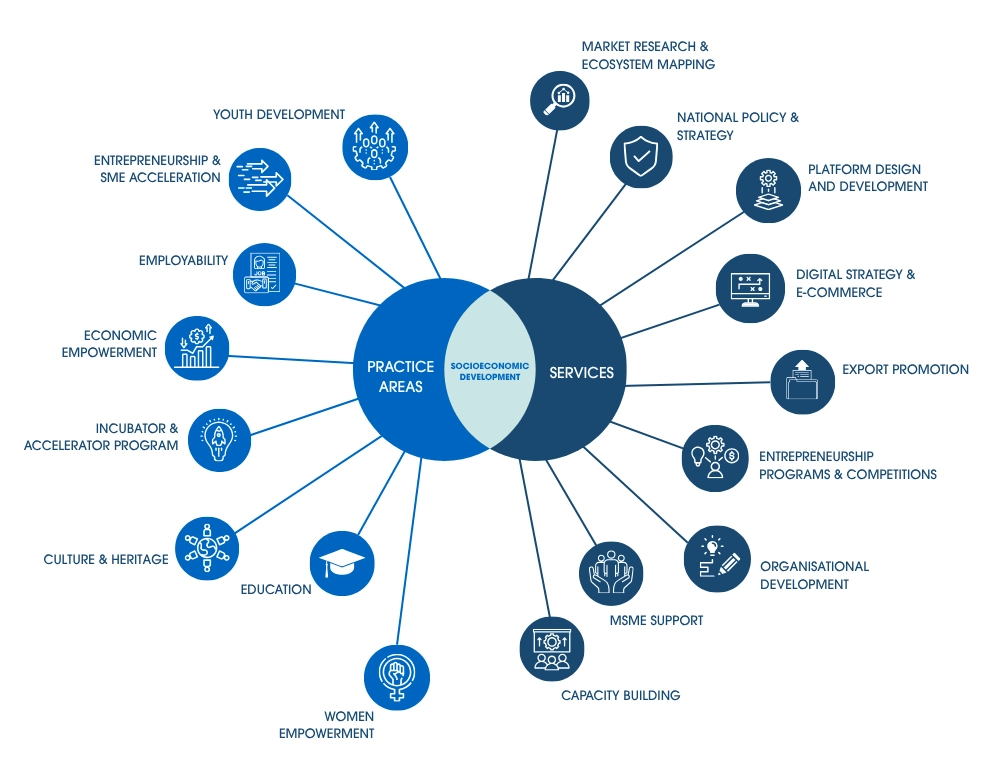
Socioeconomic development is the process of improving both the economic and social conditions of communities. It goes beyond GDP growth to address education, healthcare, job creation, and inclusive opportunities. At Innovety, we see it as building systems where youth, women, and MSMEs can access skills, markets, and resources — creating stronger economies and more equitable societies. Without it, countries risk high unemployment, limited innovation, and widening inequality.
The most powerful drivers include education and skills development, healthcare access, infrastructure, entrepreneurship support, and social inclusion. When these areas improve, people gain employability, businesses grow, and governments can deliver better services. For example, digital transformation and export readiness are now critical factors shaping competitiveness. Innovety designs integrated programs that connect these drivers to deliver measurable impact.
By creating opportunities for decent work, entrepreneurship, and skills-building, socioeconomic development directly addresses the root causes of poverty. It also ensures that women, youth, and marginalized groups are not left behind. For instance, micro-enterprise training, digital tools, and market access initiatives give vulnerable populations pathways to sustainable income. This translates into reduced income gaps and stronger, more resilient communities.
Education and skills training are the backbone of socioeconomic progress. Future-ready skills — from digital literacy to entrepreneurship — allow individuals to secure jobs or create their own businesses. Innovety partners with governments, universities, and NGOs to co-design learning pathways that match employer demand, preparing youth and women for meaningful participation in the labor market. This creates a skilled workforce that drives both innovation and inclusive growth.
Sustainability ensures that development today does not compromise future generations. Green innovation, climate resilience, and ESG-aligned programs strengthen both economies and communities. For example, adopting circular economy models or clean energy solutions not only creates new jobs but also protects natural resources. Linking socioeconomic development with sustainability enables countries to align with the UN Sustainable Development Goals (SDGs) while driving long-term competitiveness.
Effective programs include youth employability initiatives, startup and MSME support, incubator and accelerator development, digital adoption, and export readiness strategies. At Innovety, our work has ranged from building public sector capacity to designing digital platforms that expand market access. Each program is evidence-based, co-created with stakeholders, and focused on measurable results such as job creation, revenue growth, and social inclusion.
Economic development focuses primarily on financial growth, investment, and industrial expansion. Socioeconomic development, on the other hand, integrates the social dimension — ensuring that growth is inclusive, equitable, and sustainable. This means prioritizing education, healthcare, and social equity alongside business competitiveness and market expansion. In short: economic growth is about numbers; socioeconomic development is about people and prosperity together.
Turning Challenges into Opportunities for Growth.







Under the EU-funded BESTMEDGRAPE project, Berytech in Lebanon sought to create startups by turning wine industry by-products into bioactive health products. Innovety was engaged to deliver a capacity-building program for 30 aspiring entrepreneurs.
Designed and delivered a program covering entrepreneurial fundamentals, business structuring, and internationalization. Provided hands-on coaching throughout, enabling participants to refine ideas and produce polished final pitch decks.
Designed and delivered the NexLabs Summer School Bootcamp to support MSMEs, entrepreneurs, innovators, and researchers from the EU-Mediterranean region in commercializing solutions within the Water, Energy, and Food (WEF) Nexus. The aim was to transform their innovations into market-ready projects.
Developed tailored training materials for the WEF Nexus sector and delivered an intensive bootcamp covering business model creation, financial projections, and IP protection. Facilitated interactive, hands-on workshops using real case studies and provided individualized feedback on business plans, alongside post-training mentorship to guide participants toward commercialization.
To address youth unemployment in Southern Jordan, intensified by COVID-19, Innovety partnered with local stakeholders to expand labor market access for youth, women, refugees, and persons with disabilities. The project aimed to build digital, technical, and soft skills while enabling universities, chambers, and business support organizations to drive inclusive ICT-led opportunities.
We conducted market research to align curricula with in-demand digital skills, then delivered training on digital work, MSME digitization, and employability. Capacity-building workshops strengthened 50 institutions, while mentorship and tailored job placement services supported graduates in applying their skills and integrating into the workforce.

CIB sponsored an innovation program for Enactus Egypt students at the British University in Egypt, aiming to strengthen their capacity in creative problem-solving, ideation, and design thinking. The initiative sought to instill a culture of innovation, equip students with practical tools, and help them apply fresh approaches to their projects and entrepreneurial ventures.
Designed and delivered interactive workshops on innovation fundamentals, blending theory with hands-on practice. Students applied creative problem-solving and design thinking directly to their Enactus projects, ensuring real-world impact. Beyond skills, the program fostered collaboration and peer learning, while connecting students with CIB representatives and building a wider community of innovation-driven leaders.
DANIDA supported a comprehensive program for Egyptian startups and SMEs to foster innovation, improve business models, and drive growth. The program targeted startups such as Bey2olak (traffic solutions), Wuzzuf (recruitment platform), and Elmenus (food discovery platform), aiming to refine their business models, enhance digital marketing strategies, and scale their operations sustainably.
Innovety worked with each startup to refine their business models for scalability and market fit, aligning offerings with customer needs. Developed tailored SEO, social media, and content campaigns to enhance online visibility and customer acquisition. Delivered hands-on mentorship and training for founders and teams, focusing on decision-making, marketing optimization, and growth management.

This project aimed to increase the economic independence of 200 Syrian refugees and vulnerable Egyptians by providing tailored business development support. It focused on enhancing operational capacity, market competitiveness, and fostering socio-economic inclusion to enable these entrepreneurs to achieve long-term sustainability.
We conducted a comprehensive needs assessment using an enhanced Business Model Canvas and SWOT framework to analyze start-ups’ needs and challenges. Designed and delivered five tailored training sessions for 200 start-ups on business model development, operational planning, and scalability strategies. Collaborated with PLAN and Life Makers staff, who shadowed our team to ensure knowledge transfer for continued beneficiary support.

This project aimed to equip entrepreneurs at TIEC accelerators in Cairo, Assiut, Mansoura, and Alexandria with practical business and innovation skills. It focused on enabling participants to identify and capture business opportunities, navigate technology commercialization, and strengthen their ventures for long‑term growth.
We designed and delivered a 14‑day comprehensive training program across 3 rounds, covering technology commercialization, innovation management, business modelling, and financial planning. Participants also received one‑on‑one mentorship to apply these learnings to their own projects, ensuring hands‑on experience and customized guidance for growth.

This GIZ‑funded project aimed to improve access to mentorship for entrepreneurs in three governorates of Egypt, targeting startups in the post‑incubation, pre‑scaling phase. The initiative sought to build a sustainable mentorship culture by training seasoned entrepreneurs as mentors and matching them with early‑stage entrepreneurs to foster business growth.
Ran 2 outreach rounds across 3 governorates, attracting 321 applicants, and selected 69 startups and 89 mentors. Innovety designed and delivered capacity‑building workshops for mentors, mentees, and partners, followed by structured matchmaking to ensure strong mentor‑mentee alignment. Guided mentorship sessions designed to build entrepreneurial resilience and scaling readiness.

This project aimed to empower youth in Sharkeya and Beni Suef by enhancing their social entrepreneurship skills, helping them launch community‑driven enterprises that create jobs and foster inclusive economic growth. It sought to build a culture of entrepreneurship as a tool for social change and poverty reduction.
Implemented a coaching program, starting with the design of a tailored coaching plan and moving through in‑person and online mentorship sessions. Youth groups were guided to refine their enterprise proposals, enhance their social and business impact strategies, and present final concepts at a donor‑attended conference to seek support for implementation.

In partnership with UN Women, NCW, MoTI, and MSMEDA, UNIDO launched this program to increase women’s economic participation in Egypt’s private sector. Targeting Giza, Beni Sueif, Fayoum, and Minya, the program aimed to enhance entrepreneurial skills, reduce gender‑specific barriers, and empower women as entrepreneurs, employees, and agents of change.
Developed tailored training materials and a comprehensive guidebook, delivering a structured program to strengthen women’s entrepreneurial skills. Using robust M&E tools, we trained 604 women across four governorates, guiding each in creating a business plan. Plans were scored to identify 300 high-potential ventures for further support, alongside actionable recommendations for sustained impact.