At Innovety, we create end-to-end socioeconomic development programs that deliver measurable results for people and economies.
We design skill development programs so public sector institutions can deliver better services, youth and women can access decent work or start their own businesses, and MSMEs can scale into new markets.
This isn’t abstract development, it’s about delivering:
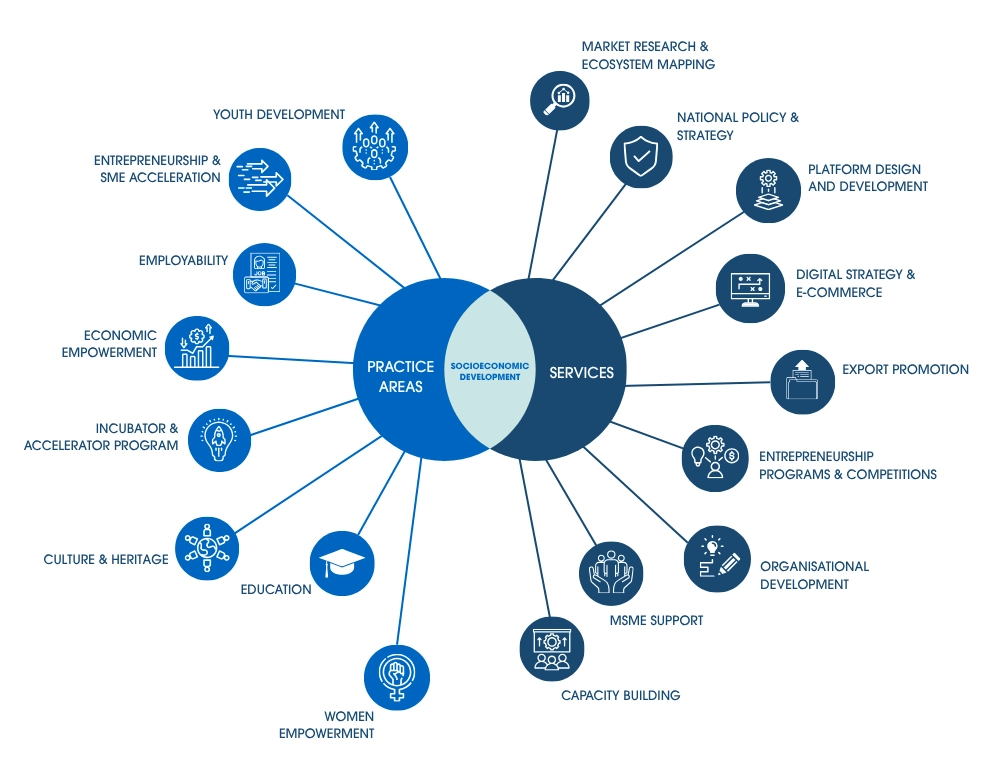
Socioeconomic development is the process of improving both the economic and social conditions of communities. It goes beyond GDP growth to address education, healthcare, job creation, and inclusive opportunities. At Innovety, we see it as building systems where youth, women, and MSMEs can access skills, markets, and resources — creating stronger economies and more equitable societies. Without it, countries risk high unemployment, limited innovation, and widening inequality.
The most powerful drivers include education and skills development, healthcare access, infrastructure, entrepreneurship support, and social inclusion. When these areas improve, people gain employability, businesses grow, and governments can deliver better services. For example, digital transformation and export readiness are now critical factors shaping competitiveness. Innovety designs integrated programs that connect these drivers to deliver measurable impact.
By creating opportunities for decent work, entrepreneurship, and skills-building, socioeconomic development directly addresses the root causes of poverty. It also ensures that women, youth, and marginalized groups are not left behind. For instance, micro-enterprise training, digital tools, and market access initiatives give vulnerable populations pathways to sustainable income. This translates into reduced income gaps and stronger, more resilient communities.
Education and skills training are the backbone of socioeconomic progress. Future-ready skills — from digital literacy to entrepreneurship — allow individuals to secure jobs or create their own businesses. Innovety partners with governments, universities, and NGOs to co-design learning pathways that match employer demand, preparing youth and women for meaningful participation in the labor market. This creates a skilled workforce that drives both innovation and inclusive growth.
Sustainability ensures that development today does not compromise future generations. Green innovation, climate resilience, and ESG-aligned programs strengthen both economies and communities. For example, adopting circular economy models or clean energy solutions not only creates new jobs but also protects natural resources. Linking socioeconomic development with sustainability enables countries to align with the UN Sustainable Development Goals (SDGs) while driving long-term competitiveness.
Effective programs include youth employability initiatives, startup and MSME support, incubator and accelerator development, digital adoption, and export readiness strategies. At Innovety, our work has ranged from building public sector capacity to designing digital platforms that expand market access. Each program is evidence-based, co-created with stakeholders, and focused on measurable results such as job creation, revenue growth, and social inclusion.
Economic development focuses primarily on financial growth, investment, and industrial expansion. Socioeconomic development, on the other hand, integrates the social dimension — ensuring that growth is inclusive, equitable, and sustainable. This means prioritizing education, healthcare, and social equity alongside business competitiveness and market expansion. In short: economic growth is about numbers; socioeconomic development is about people and prosperity together.
Turning Challenges into Opportunities for Growth.







IOM partnered with Innovety to enhance the employability and entrepreneurial capacity of migrants and host community members in Ard El Lewa. The program aimed to transfer practical knowledge on starting and managing projects, creating sustainable livelihood opportunities, and fostering social cohesion.
Launched a targeted outreach campaign reaching 23,952 Egyptians and 5,906 migrants, resulting in 114 applications. Following a careful selection process, 43 participants joined a multi‑phase entrepreneurship program combining opportunity identification and business realization workshops. We provided 38 participants with mentorship and engaged local NGOs, including Woman and Society, to ensure program sustainability.
In response to the socio‑economic challenges following the Arab Spring, IOM partnered with Innovety to promote entrepreneurship in Menoufeya and Fayoum. The program aimed to equip youth with the skills needed to launch startups, organize business plan competitions, and link winning teams to funding institutions.
We delivered an intensive entrepreneurship and mentorship bootcamp covering business planning, market analysis, marketing, finance, innovation, and pitching. Participants received one‑on‑one mentorship to refine their ideas and prepare for a final business plan competition, where top teams pitched to potential investors for seed funding.
With USAID support, this project aimed to foster economic development in the Delta region by equipping youth and students in El‑Mansoura with entrepreneurial skills. It focused on building their capacity to start, manage, and grow sustainable businesses while linking promising projects to potential funders.
We conducted an extensive outreach and selection process, evaluating 490+ applications and engaging participants in a structured entrepreneurship bootcamp covering innovation, market analysis, finance, marketing, and operations. Business plan mentoring prepared participants for a pitching competition, where top projects were selected and received tailored mentoring to refine their business models.

Under UNIDO’s Women’s Economic Empowerment program with UN Women, NCW, MoTI, and MSMEDA, this initiative aimed to strengthen five government entities in Greater Cairo, Alexandria, Beni Suef, Fayoum, Minya, and Beheira to better serve women entrepreneurs in palm dates, MAPs, handicrafts, and ICT sectors.
We assessed institutional capabilities, identified key skill gaps, and trained 47 officials on entrepreneurship trends, program design, M&E, digital outreach, and donor engagement. We also guided teams in developing and pitching new program concepts for potential UNIDO funding.

In partnership with CARE, Innovety enhanced the innovation and entrepreneurship teaching capabilities of university professors in Jordan. The program aimed to transfer advanced knowledge, models, and best practices to professors, enabling them to integrate innovation and entrepreneurship into academic programs and increase youth employability through the Faculty for Factory National Program.
Innovety delivered an online ToT program using our “Know / How to / Do” framework, blending theory with practical application. Through interactive workshops, case studies, and post-training mentorship, professors were equipped with the skills to develop and deliver impactful innovation and entrepreneurship curricula.
As part of the African Presidential Leadership Program, Innovety was engaged by the National Institute of Governance and Sustainable Development to deliver a session on Innovation in Government. The session aimed to equip 100 women leaders from 50 African countries with tools and knowledge to drive innovation and sustainability in governance.
Innovety delivered an interactive session introducing public sector innovation frameworks, emphasizing the integration of sustainability. The workshop used real-world examples and participatory methods to inspire creative thinking and practical application in participants’ home governments.
Under the GESR initiative, Misr El Kheir Foundation partnered with Innovety to strengthen employee capabilities in communication, reporting, and personal development. The program also introduced product innovation principles to help staff embed creativity and design thinking into the foundation’s operations.
We delivered a comprehensive training program covering 25+ soft skills modules tailored to employees’ roles, enhancing communication, reporting, and personal effectiveness. A dedicated Product Innovation course introduced participants to design thinking and innovation fundamentals, while interactive workshops ensured practical application of learned skills within the organizational context.

This program aimed to enhance the capabilities of government institutions, universities, and SMEs in Libya to drive innovation and economic growth. It focused on improving public service delivery, strengthening strategic planning, and fostering entrepreneurship in challenging environments.
Delivered training for government staff and university students in strategic planning, project management, and innovation management. Facilitated research-driven sessions to identify opportunities for entrepreneurship centers, and worked with ministries and international organizations to develop tailored innovation strategies, supported by ongoing mentoring and capacity building.